Sewer Line Replacement in Sarasota, FL
Sometimes the honest answer is a new pipe in a new trench. When a Sarasota sewer line has lost its grade, collapsed beyond repair, or failed in ways no-dig methods cannot correct, full excavation replacement gives you a fresh start with proper slope and modern materials.
When Excavation Is the Right Call
Trenchless methods get most of the attention, and they deserve it, but they are not universal. Some sewer lines are beyond what no-dig repair can correct, and for those lines the right answer is the oldest one in the trade: open the ground, remove the failed pipe, and lay a new line correctly.
Excavation is the right call when the camera shows a belly, a sagging section holding standing water, because a belly is a grade problem and grade can only be fixed by re-laying pipe. It is the right call when the pipe has failed along most of its length rather than at isolated defects, when collapses have destroyed the line's shape beyond what bursting can follow, and when there is no workable access for trenchless equipment. In these cases, recommending a no-dig method would not be creative problem-solving; it would be installing a repair designed to fail.
The point is not that excavation is better than trenchless. The point is that the pipe's condition decides the method, and the camera reveals the condition. A contractor who only sells trenchless will try to make every line fit it. We do both, which means we can recommend excavation when excavation is what the footage calls for, and show you exactly why.
The Repair-vs-Replace Decision Framework
When the camera inspection is complete, the findings sort into a decision framework. It is not complicated, but it is disciplined, every line gets evaluated the same way.
Localized Damage, Sound Pipe: Repair
A crack here, root intrusion at two joints there, with the rest of the line round, graded, and intact, this is a rehabilitation case. CIPP lining seals the defects into a new jointless interior without disturbing the surface.
Collapsed or Systemically Failed Pipe, Grade Intact: Bursting
Pipe that has collapsed, heavily offset, or corroded beyond rehabilitation, but still follows its original alignment, is a pipe bursting case. The old pipe is fractured outward and a new jointless pipe takes its path.
Lost Grade or Pervasive Failure: Replacement
A belly holding water, multiple collapses along the run, a line whose material has failed end to end, this is where excavation earns its place. Only an open trench lets a crew re-establish the downhill slope the line was supposed to have and lay new pipe to that grade.
What Else Factors In
Beyond the footage, the framework weighs the pipe's material and age, the soil and water table at the site, the feasibility of access pits, and your plans for the property. A line with five good years left in a yard you plan to regrade anyway is a different decision than the same line under a new pool deck. The framework is technical, but the recommendation is practical.
Grade Problems Need a New Trench
Of all the defects a camera finds, the belly is the one most often misunderstood, and the one that most firmly requires excavation. A belly forms when saturated sandy soil stops supporting the pipe and a section sags, losing its downhill slope. Wastewater still flows in, but solids settle in the low spot, water ponds, and the line begins a slow cycle of partial blockages, jetting visits, and repeat backups.
Here is why no trenchless method fixes it. Pipe bursting pulls the new pipe along the old pipe's alignment, sag included. CIPP lining cures into the shape of the host pipe, sag included. Both methods inherit the geometry they start with. A new pipe with the old sag is a new pipe with the old problem, and installing one would be malpractice disguised as innovation.
Excavation breaks the cycle. The sagging section is exposed, removed, and the trench bottom is re-graded to restore continuous downhill slope before the new pipe goes in. The line that results does not just look new on camera, it drains the way a sewer line is supposed to drain, by gravity, without low spots. In Sarasota's high-water-table soils, where bellies are among the most common serious defects, this distinction matters on nearly every replacement we evaluate.
Sarasota Soil and Water-Table Realities
Excavating in Sarasota means excavating in sand with water in it. The county's dominant Myakka fine sand, joined in many areas by poorly drained EauGallie fine sand, does not stand vertically the way clay does. Open a trench in dry sand and the walls slough; open one in saturated sand and they flow. Across much of the county, the seasonally high water table sits between zero and three and a half feet below the surface, which means a sewer trench will likely meet groundwater before it reaches the pipe.
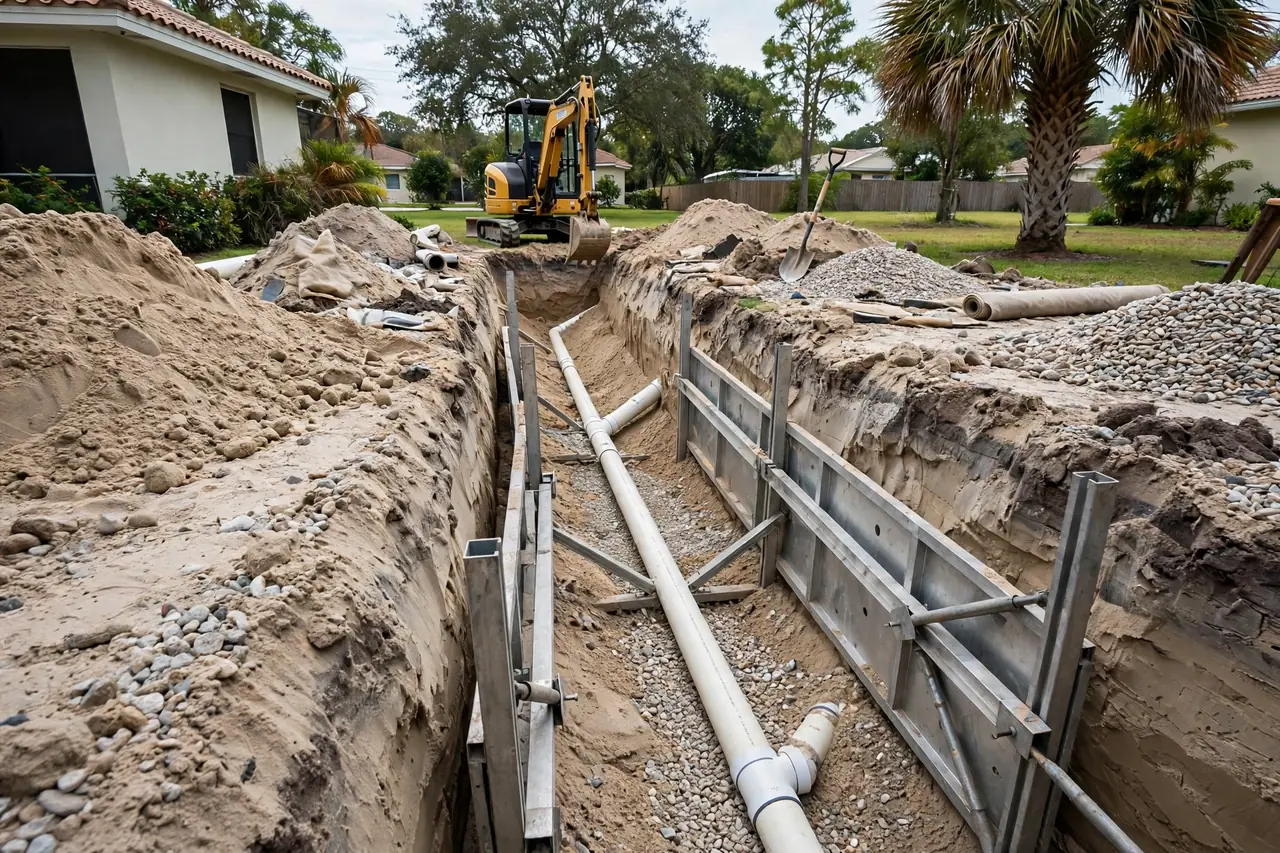
This does not make excavation impractical. It makes it a discipline. Trenches are shored, supported with trench boxes or shoring panels, so the walls cannot collapse on the work or the workers. Groundwater is managed with pumps so the crew can bed and lay pipe in a dry trench rather than underwater. And the work is scheduled with the calendar in mind: the June to September rainy season delivers roughly sixty percent of the area's annual rainfall, with August the wettest month, so a major excavation is better planned for the drier months when the water table sits lower and afternoon storms are less likely to flood an open trench.
None of this is improvised. Shoring, dewatering, and weather planning are standard parts of every excavation estimate we prepare, which is also why an excavation planned from camera footage and soil knowledge costs less in surprises than one planned from a guess.
What the Replacement Process Looks Like
Locate and Plan
The camera footage and surface markings from the inspection define the trench: its path, its depth at each point, and the location of every defect. Nearby utilities are identified and marked. The route is walked with you before anything is dug, so there are no surprises about what the trench will cross.
Excavate
The trench is opened along the lateral's corridor, with shoring installed as it deepens and groundwater pumped as needed. The failed pipe is exposed along the full run and removed.
Bed and Lay
The trench bottom is graded to restore proper downhill slope, this is the step that fixes the belly, and bedded with stable material. The new PVC pipe is laid to that grade, jointed with solvent welds, and connected at the house and at the main. Cleanouts are installed for future access.
Verify
Before backfill, the new line is camera-inspected to confirm continuous grade, sound joints, and clear flow. This is the same verification standard we apply to trenchless work: the finished pipe is proven, not assumed.
Backfill and Restore
The trench is backfilled in lifts and compacted to prevent future settling, important in sandy soil, where an under-compacted trench becomes tomorrow's belly. The surface is restored: soil, sod, pavers lifted and reset, plantings replaced where the trench crossed them.
Depth, Access, and Property Protection
The two questions every homeowner asks about excavation are how deep and how destructive. Depth follows the existing line: the trench goes as deep as the lateral already runs, which the camera inspection measures in advance. Most residential laterals are within a few feet of the surface at the house, deepening toward the main, the plan shows you the profile before work starts.
Disruption is managed by planning. The trench follows the lateral's existing corridor, which is already an easement of disturbed ground, rather than cutting a new path. Where the corridor crosses a paver driveway, the pavers are lifted, stacked, and reset, not demolished. Where it crosses planting beds, the plants are moved and replanted. Heavy equipment stays on planned paths, and the work area is kept as tight as the shoring and the pipe allow.
An open trench is more disruptive than two access pits; there is no honest way to say otherwise. What planning buys is the difference between a trench that crosses the yard with intent and one that wanders through it. You will know the route, the depth, the duration, and the restoration plan before the first shovel touches soil.
Modern Materials, Proper Slope
What goes into the trench matters as much as how the trench is dug. Replacement pipe is PVC: smooth-bored, corrosion-proof, and joined with solvent welds that fuse each joint into a continuous run. Against the materials it replaces, the advantages are direct. Clay tile's joints, a root entry every few feet, are gone. Cast iron's internal corrosion and scaling, the slow narrowing of the bore over decades, cannot happen in plastic. The smooth interior carries solids cleanly, and the fused joints give roots nothing to exploit.
Proper slope is the other half of the equation, and it is the reason excavation exists. A sewer lateral drains by gravity alone, which means the grade has to be right along every foot of the run, enough fall to keep solids moving, not so much that water outruns them. The re-graded trench bottom is set to that grade before a single length of pipe goes in, and the post-installation camera pass confirms it. The line that results is not just new pipe; it is correct pipe, laid the way the original should have been.
Cleanouts complete the installation: accessible capped risers at the house end and near the property line that turn every future maintenance task, a camera check, a jetting visit, a root cutting, into a simple operation through an opening rather than a new excavation.
After Replacement: Keeping the New Line Healthy
A new PVC lateral in properly compacted sand is the lowest-maintenance sewer line a Sarasota home can have, but a few habits protect the investment. Do not plant trees over or near the lateral's path; the mature live oaks and ficus trees that destroyed the old clay and cast-iron lines will probe a new line's joints too, even fused ones, given decades. Keep deep-rooted plantings well clear of the corridor, and choose planting locations with the marked cleanouts as your guide to where the line runs.
Keep the cleanouts accessible and capped. They are the access points that make future camera inspections and hydro jetting straightforward, and a buried or paved-over cleanout defeats its own purpose. And if roots were the reason the old line failed, consider a periodic camera check every few years, early root contact at the house connection is a quick jetting visit, not a crisis, when it is caught early.
A replaced line should serve the house for the long term. The way to make sure of it is the same way the replacement was planned: look inside it now and then, and act on what the camera shows. Call (941) 344-0088 if you want a professional read on whether your line is a repair case or a replacement case, the inspection is where every answer starts.
Sewer Line Replacement Across Sarasota
We bring sewer line replacement to homes throughout Sarasota and nearby Gulf Coast cities.
Related Reading
7 Signs Your Sewer Line Is Failing (Sarasota Edition)
Seven signs your Sarasota sewer line is failing: slow drains, gurgling, odors, and backups. Call (941) 344-008…
Learn more →
Cast-Iron Sewer Pipe in Sarasota Slab Homes: What to Know
Cast-iron sewer pipe under Sarasota slab homes from the 1960s to 1980s is corroding. Learn the signs and repai…
Learn more →Frequently Asked Questions
When is sewer line replacement better than trenchless repair?
When the camera shows a grade problem, a belly or sag that holds standing water, or when the pipe has failed along most of its length rather than at isolated spots. Trenchless methods follow the existing alignment, so they cannot correct lost slope, and lining needs a sound host pipe. Excavation re-establishes proper grade with new pipe, which is the only durable fix for these conditions.
Can a bellied sewer line be fixed without digging?
No. A belly is a sagging section where the pipe has lost its downhill slope. Both pipe bursting and CIPP lining follow the existing alignment, so a no-dig repair would reproduce the sag in the new pipe. The only way to restore proper slope is to open the ground, remove the sagging section, and re-lay pipe at the correct grade. That is excavation.
How deep will the trench be?
It varies with the property. The trench follows the existing lateral's depth, which depends on how deep the line was originally installed and how far it runs to the main. The camera inspection measures the line's depth at each defect before any digging is planned, so the excavation plan is based on your actual pipe, not on an estimate.
Will replacement destroy my landscaping or driveway?
The trench path is planned to minimize surface damage: it follows the lateral's existing corridor, and access is staged to avoid the most valuable landscaping where possible. Pavers can be lifted and reset, and disturbed areas are backfilled, compacted, and restored. An open trench is more disruptive than trenchless work, that is unavoidable, but a planned excavation is far less destructive than an unplanned one.
What pipe material is used for replacement?
Modern replacement uses PVC: a smooth, jointless-when-fused pipe with solvent-welded joints that resist root intrusion far better than the clay tile and cast iron it replaces. PVC does not corrode, does not scale internally the way cast iron does, and carries a long service life in Sarasota's sandy soil. Cleanouts are installed for future access.
How long does a full sewer line replacement take?
Many residential replacements are completed within a few days, depending on the length and depth of the run, soil and groundwater conditions, and surface restoration. The camera inspection and planning happen first, so the excavation itself proceeds without exploratory digging. Your technician will lay out the expected sequence before work begins.
Does high groundwater complicate excavation in Sarasota?
It can. Across much of Sarasota County the seasonally high water table sits between zero and three and a half feet, and the dominant Myakka fine sand sloughs easily when saturated. Open trenches need shoring and often dewatering, and work is best scheduled outside the heaviest June to September rains when possible. These are known conditions we plan for, not surprises.
Should new cleanouts be installed with the replacement?
Usually, yes, and we recommend it. Accessible cleanouts at the house and at the property line turn future maintenance, jetting, camera checks, root cutting, into simple operations instead of excavation projects. If your older home lacks cleanouts, a replacement is the natural time to add them. They are a small addition that pays off for the life of the new line.