Cast-Iron Sewer Pipe in Sarasota Slab Homes: What to Know
Homes built between the 1960s and 1980s in Gulf Gate, Bee Ridge, and similar slab subdivisions carry their drain lines inside cast-iron pipe set within or beneath the concrete slab. Here is how that pipe ages, how to tell when it is failing, and what repair options look like.
The 1960s to 80s Slab Cohort in Sarasota
Drive through Gulf Gate or Bee Ridge and the rooflines tell a story: single-story ranch homes on concrete slabs, built from the 1960s through the 1980s, when slab-on-grade construction became the standard way to build across Sarasota County. There was no crawl space, no basement, and very little room between the soil and the underside of the floor. Drainage pipe laid during this era went directly into the ground or into the slab itself, and for most of these homes the material of choice was cast-iron drain, waste, and vent piping, called DWV in the trade.
The pipe under the slab connects to the lateral that runs out to the street or to the property line cleanout. In these subdivisions, that lateral was commonly clay tile in the earlier years and cast iron later, with plenty of homes carrying both. Together, the under-slab DWV and the yard lateral make up what builders call the prime failure cohort: the largest group of homes in Sarasota whose original sewer pipe is now aging out at roughly the same time.
Why cast iron was used so widely is simple. It was quiet, strong, and the accepted standard for decades. It handled the weight of a slab poured over it and shrugged off the heat of the attic runs. Nobody designing these homes in 1972 was thinking about what six decades of Florida humidity, a seasonally high water table, and corrosive wastewater gases would do to the inside of the pipe. But time has made that question unavoidable, and homeowners in these neighborhoods are the ones facing it first.
How to Tell What Your Home Has
If you own a slab home in Gulf Gate, Bee Ridge, or a neighboring subdivision from this era and you have never had the sewer line scoped, you are working from assumptions. A camera inspection through a cleanout shows exactly which material runs under your slab, where it transitions to the yard lateral, and what condition each stretch is in. Age of the home alone is a strong clue. Homes from this window were almost universally plumbed with cast iron under the floor, but the footage removes all doubt.
How Cast Iron Fails in Florida's Soil and Water
Cast-iron pipe fails from the inside out, and Florida's environment works on both sides of the pipe wall at once. On the inside, wastewater produces hydrogen sulfide gas as organic matter breaks down in low spots and slow-moving sections. That gas reacts with moisture on the pipe crown to form sulfuric acid, which eats the metal from above. Meanwhile, dissolved minerals in the water precipitate onto the rough pipe interior and form scale, hard, crusty buildup that narrows the bore of the pipe a little more each year.
The bottom of the pipe suffers a different attack. Constant wastewater flow plus trapped grit wears the invert, the bottom interior, into a channel that technicians call channeling or a wore-out bottom. Over decades, the bottom of the pipe can erode to a thin remnant while the top still looks intact, which is exactly why a camera sees things a homeowner never would: the outside of the pipe tells you almost nothing.
Outside the pipe, Sarasota's soil does the rest. Much of Sarasota County sits on Myakka fine sand, Florida's state soil, with pockets of poorly drained EauGallie fine sand. The seasonally high water table sits just 0 to 3.5 feet below grade in large parts of the county. That means the pipe under a Gulf Gate or Bee Ridge slab often spends the rainy season submerged or sitting in saturated sand. Constant moisture against the outside of cast iron accelerates external corrosion, and saturated sand loses its ability to support the pipe evenly.
When the soil around a buried lateral softens and settles unevenly, sections of pipe sag into what plumbers call bellies, low spots where wastewater pools instead of flowing. A belly under a slab is especially damaging because it holds corrosive wastewater against the same stretch of pipe around the clock. Settling also stresses the joints between pipe sections, and a stressed joint in soft sand eventually separates, letting groundwater infiltrate and soil or roots find their way in. Cast iron under slab does not usually fail all at once. It declines in stages, scale, pitting, channeling, joint stress, separation, until flow is blocked or the pipe collapses.
Warning Signs Your Slab Sewer Line Is Deteriorating
Because the pipe is hidden under concrete, your fixtures are the early-warning system. The classic pattern in these homes is slow drainage across multiple fixtures at once, the shower backs up a little when the toilet flushes, or the kitchen sink gurgles when the washing machine drains. One slow drain is a branch-line problem. Several slow drains together point at the main line or the under-slab DWV, and in a 1970s slab home that almost always means cast iron.
Recurring clogs are the next signal. If you have had the main line cleared more than once in a couple of years, the stoppages are not random, they are landing in the same rough, scaled, or bellied section of pipe, and clearing restores flow without fixing the cause. Each clearing buys less time than the last, because the underlying deterioration keeps advancing.
Sewer odors inside the house deserve attention, especially odors that come and go with the weather. Cracked cast iron under a slab can vent sewer gas into the soil beneath the home, and pressure changes can push it through tiny gaps around pipe penetrations. A damp or stained spot on a slab-adjacent wall, unexplained moisture along the base of a bathroom, or a toilet that rocks slightly on its flange can all trace back to a failing under-slab line. None of these prove cast-iron failure by themselves. Together with the age of the home and a pattern of drainage trouble, they make a sewer camera inspection the obvious next step, and the inspection is non-invasive, done through an existing cleanout without breaking any concrete.
What a Camera Inspection Reveals Beneath the Slab
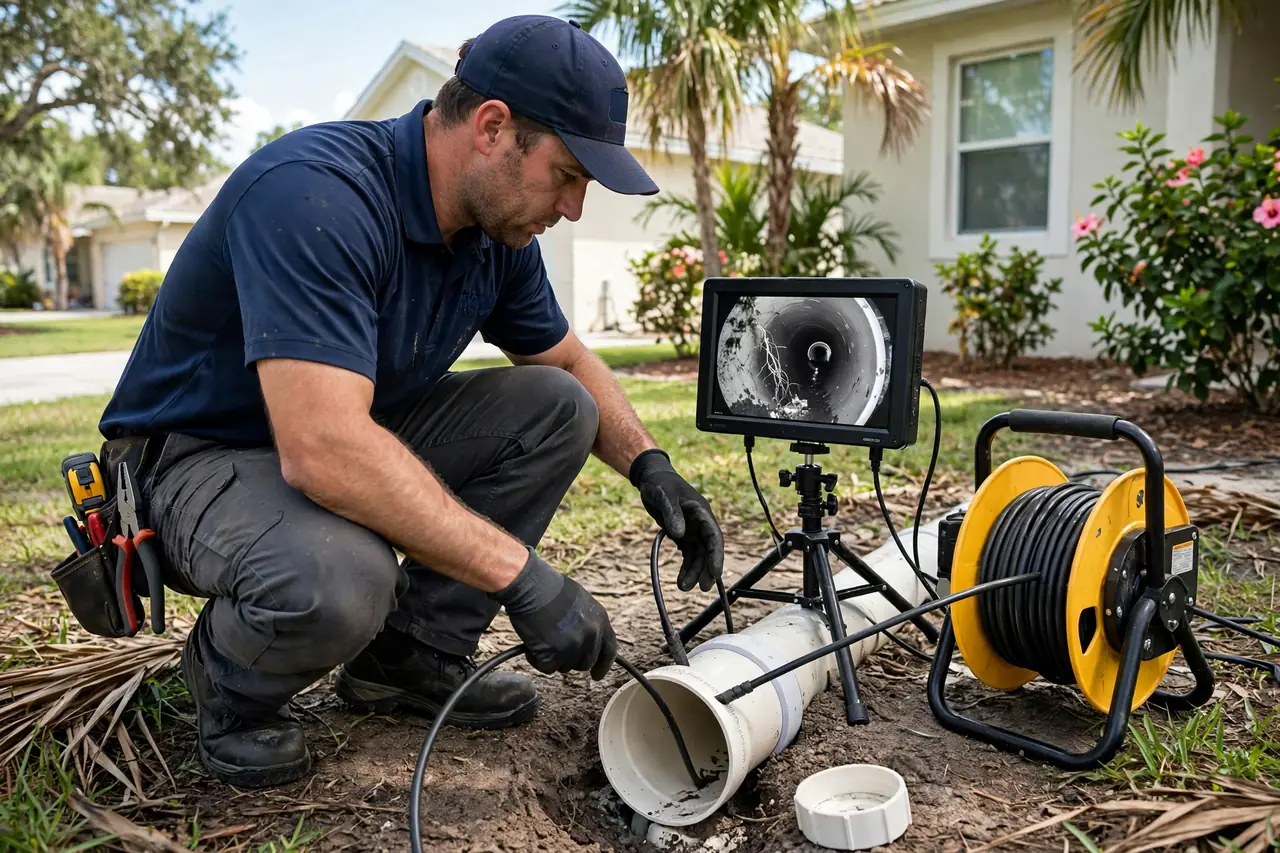
A sewer camera inspection starts at a cleanout, the capped access point on the line, usually found outside near a bathroom wall or at the property line. The technician feeds a waterproof camera head on a flexible push rod through the line while the monitor above shows the interior of the pipe in real time, with a transmitter in the camera head that lets the crew locate the camera's position and depth from the surface.
Under a slab, the camera looks for the specific signatures of cast-iron decline. Internal scale shows as rough, orange-brown crust narrowing the pipe. Pitting and corrosion appear as flaking metal and irregular surfaces. Channeling is unmistakable: a worn groove along the bottom of the pipe, sometimes with the pipe wall paper-thin or gone entirely in spots. The camera also crosses every joint, and the technician watches for offsets, separations, and root entry at each one. Bellies announce themselves as standing water in an otherwise draining line, the camera lens dips below the waterline and the picture clouds.
What matters for your repair decision is not just what the camera sees but where and how much. A long stretch of heavily scaled pipe under the middle of the slab is a different repair than one bad joint near the cleanout. The camera also shows the transition point where the under-slab DWV meets the yard lateral, because a home can have failing cast iron under the slab and a sound lateral, or the reverse, and the fix should target the actual problem. A good inspection ends with footage you can keep, a clear explanation of the worst sections, and a repair plan matched to what the pipe actually looks like.
Repair Options for Cast Iron Under a Slab
Once the camera has mapped the damage, there are three broad ways to fix cast iron under a slab. Which one fits depends on the pipe's condition, how long the damaged run is, where the worst sections sit, and how much of the home's interior and yard you are willing to disturb.
Cured-in-Place Pipe Lining
Cured-in-place pipe lining, often called CIPP, rebuilds the pipe from the inside. A resin-saturated liner is pulled or inverted into the existing cast-iron line and cured in place, forming a new smooth pipe within the old one. It needs access points rather than trenches, which makes it attractive under slabs where cutting concrete is the alternative. Lining works best when the old pipe is still round enough to host the liner, heavy scale is usually cleaned first, and when the line runs straight enough to receive it. It leaves the soil, slab, and landscaping untouched.
Pipe Bursting
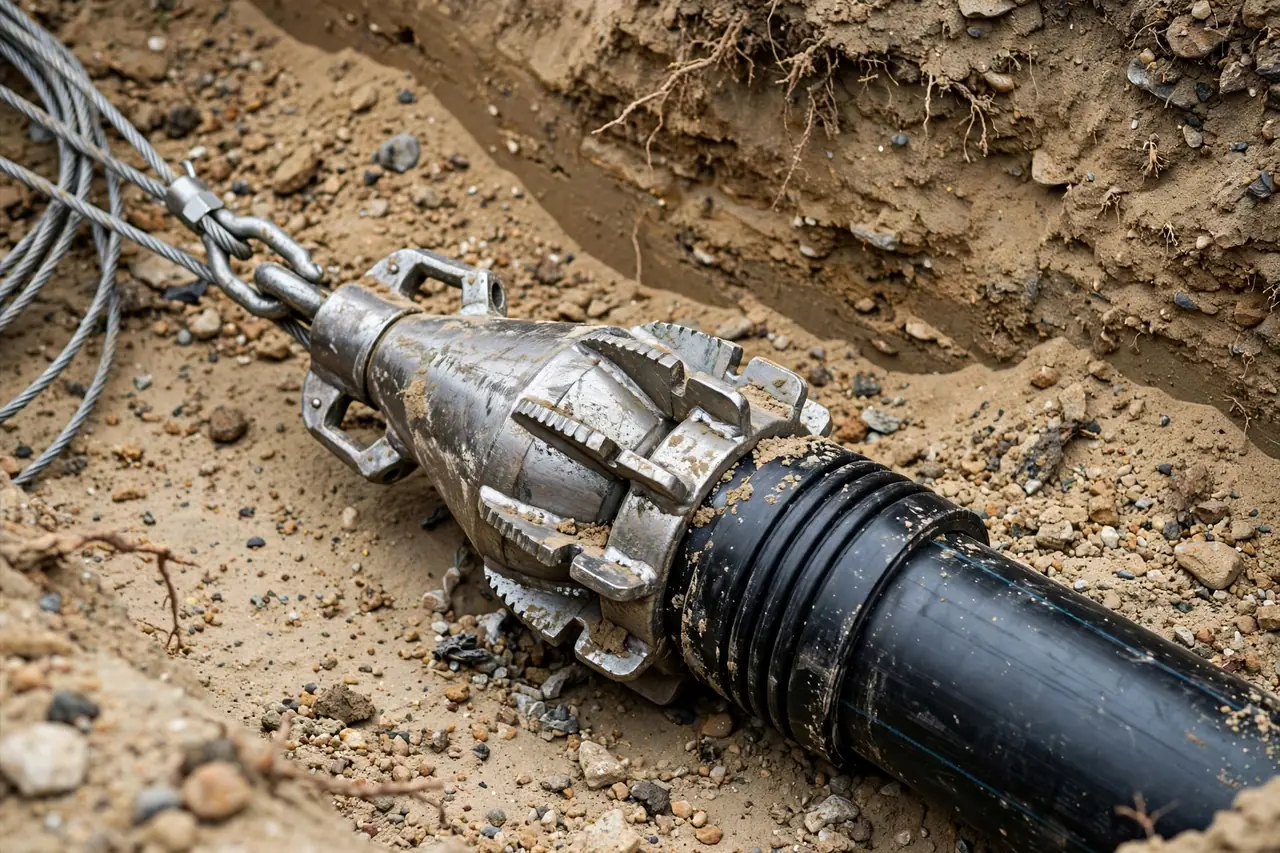
Pipe bursting replaces the line entirely without opening the slab along its whole length. A bursting head is pulled through the old cast-iron pipe, fracturing it outward while towing a new pipe into the same bore path. This is the answer when the camera shows the old pipe is too far gone to line, collapsed sections, missing bottoms, or severe channeling, but the line's path is known and straight. Like lining, it uses entry and exit pits instead of a continuous trench, so the slab above the run stays intact.
Traditional Replacement Through the Slab
The third option is conventional excavation: opening the slab over the damaged run, removing the old cast iron, and laying new pipe in the same trench before restoring the concrete. It is the most disruptive inside the home, but it is also the most direct, there is no question about what went in, and it handles situations the trenchless methods cannot, such as lines that have shifted off their original path or collapsed in ways that block a bursting head. Many homes end up with a hybrid: trenchless methods for the long straight runs, excavation for the problem sections.
One honest note: none of these is automatically right for every home. A short, accessible run with one bad joint may be simpler to repair conventionally. A long run under the middle of the house favors lining or bursting. The camera footage, not a rule of thumb, should drive the choice, which is why the inspection always comes first.
The Gulf Gate and Bee Ridge Angle
Not every Sarasota neighborhood faces the same version of this problem, and that is worth understanding if you own one of these homes. Gulf Gate was developed through the 1960s and 1970s on lots where mature landscaping is now the norm, large shade trees, established root systems, and decades of settled soil around the laterals. The cast-iron DWV under these slabs is the same age as the homes themselves, and the yard laterals run through sandy soil where the water table rises sharply every rainy season. Roots from mature live oaks and ficus trees add a second failure mode on top of corrosion: they find their way into stressed joints and accelerate separation.
Bee Ridge tells a similar story with its own twist. The corridor carries a mix of 1960s to 80s slab homes, and the area has seen real flooding events. Tropical Storm Debby in August 2024 brought inland flooding that included Bee Ridge, and the saturated ground that followed put every buried lateral in the area through exactly the stress cycle that separates joints. Homes near Phillippi Creek and the low-lying pockets along the corridor sit where the water table is highest, which means their pipe spends more of each year submerged.
If you live in either neighborhood and your home has its original plumbing, a Gulf Gate sewer line evaluation or an equivalent inspection elsewhere in the corridor is not alarmism, it is maintenance on a pipe that is now sixty-plus years old in an environment that ages pipe faster than most. The same logic applies across the 1960s to 80s slab subdivisions: Southgate, the North Tamiami Trail corridor, and the older parts of the Bee Ridge area all share the same pipe era and the same soil.
Extending the Life of Your Sewer Lines
A cast-iron line under a slab that is still in reasonable shape is worth protecting. The single most effective maintenance step is periodic cleaning with a hydro-jetting service rather than repeated mechanical snaking. Jetting scours scale and grease from the pipe walls with high-pressure water, which both restores flow and gives a later camera inspection a clear view of the pipe itself. For an older cast-iron line, a jetting schedule, say every couple of years, adjusted to what the camera shows, costs little compared to what it prevents.
What goes down the drains matters more than most homeowners realize. Grease, coffee grounds, and so-called flushable wipes are the three worst offenders for older cast iron: they catch on rough scale and turn a narrowed pipe into a blocked one. Harsh chemical drain cleaners deserve a warning of their own, the caustic heat they generate attacks already-thinned cast iron and can finish off a section that was otherwise holding on.
Landscaping choices count too. If you are planting new trees in a yard with a known lateral path, put thirsty species with aggressive roots far from the line. Mature trees near an aging lateral are not an automatic emergency, but they are a reason to keep the camera on a schedule rather than waiting for the first backup. And after any repair, lined, burst, or replaced, ask for the post-repair camera footage and keep it. That recording is the baseline for every future inspection, and it documents exactly what was done and where, which is valuable information the next time the line needs attention or the home changes hands.
Published 2026-10-09 · Sarasota Sewer Specialists
Related Sewer Services
Sewer Camera Inspection
Sewer camera inspection in Sarasota, FL finds roots, scale, bellies & breaks before you dig. HD video diagnosi…
Learn more →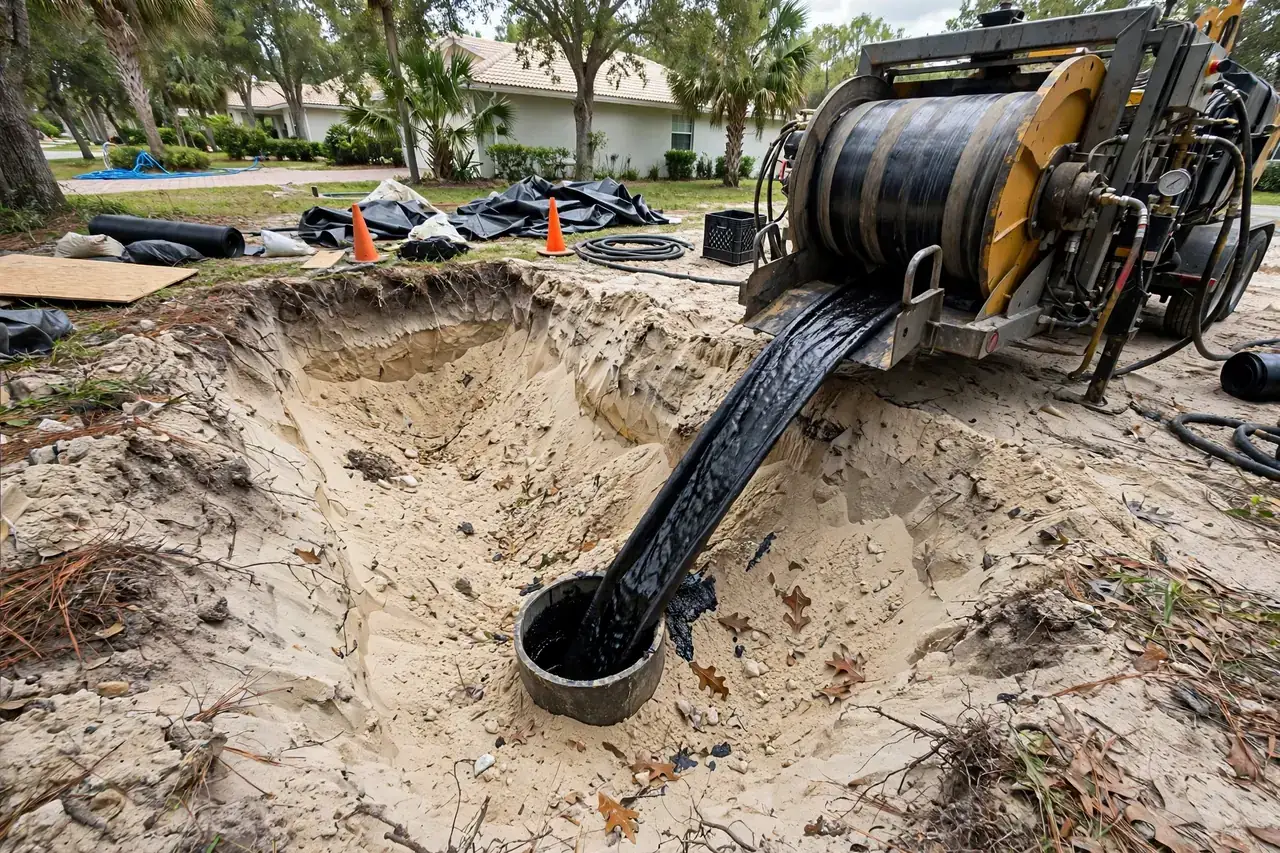
CIPP Pipe Lining
CIPP pipe lining in Sarasota, FL creates a new pipe inside the old one: no trench. Camera inspection, cleaning…
Learn more →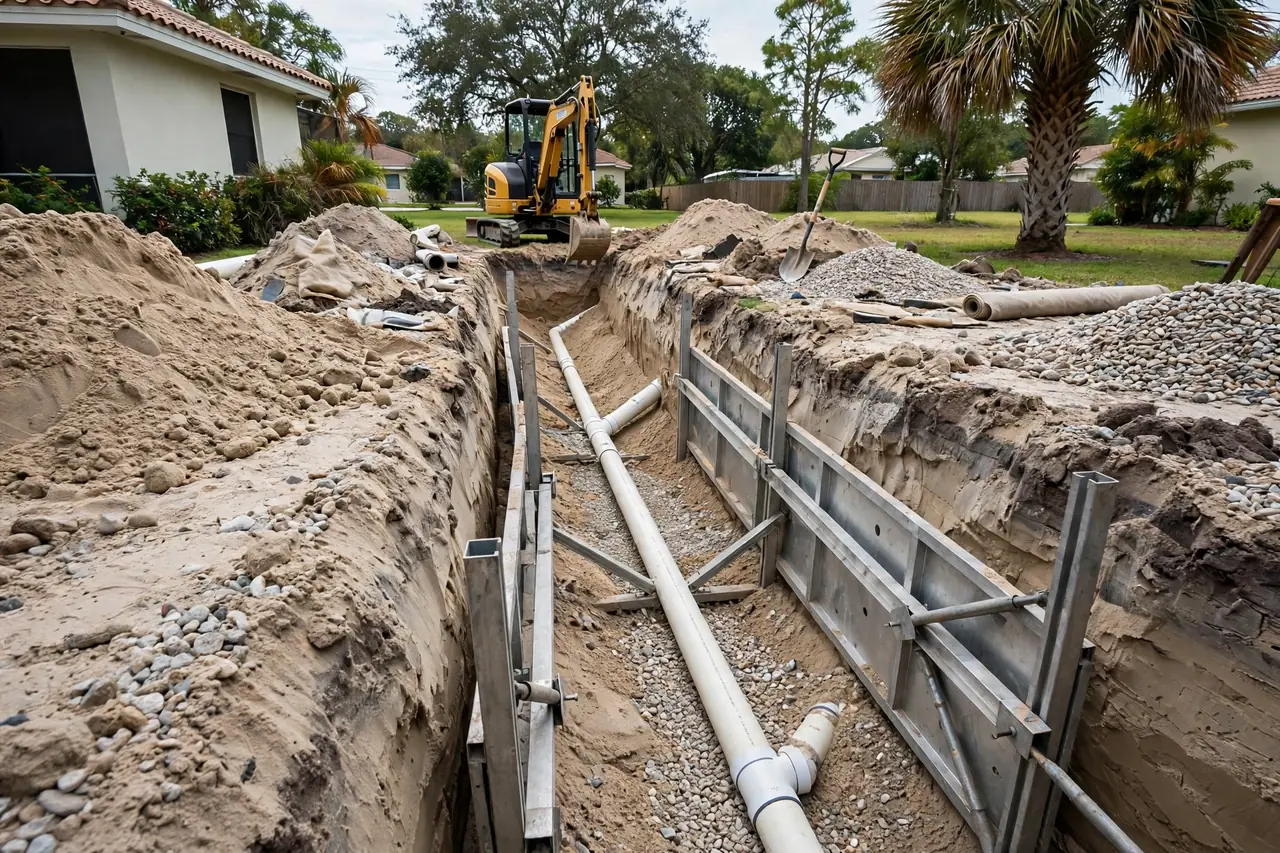
Sewer Line Replacement
Sewer line replacement in Sarasota, FL by excavation when trenchless won't work: proper grade, modern PVC pipe…
Learn more →Frequently Asked Questions
How do I know if my Sarasota home has cast-iron sewer pipe under the slab?
Homes built from the 1960s through the 1980s in Sarasota's slab subdivisions were almost universally plumbed with cast-iron drain pipe under the floor. The only way to be certain is a camera inspection through a cleanout, which shows the material, the joints, and the condition of every section. Your home's build year is a strong clue, but the footage is proof.
Can cast-iron pipe under a slab be repaired without breaking the concrete?
Often, yes. Cured-in-place pipe lining rebuilds the line from the inside using access points, and pipe bursting pulls a new pipe through the old one's path, both avoid cutting the slab along the run. These methods need the pipe to be round enough and clear enough to receive them, which is exactly what the camera inspection determines before any repair is chosen.
How long does cast-iron sewer pipe last in Sarasota's soil?
Cast iron was designed for many decades of service, but Sarasota's environment is hard on it: a seasonally high water table of 0 to 3.5 feet, saturated Myakka fine sand, and corrosive wastewater gases working the pipe from the inside. Many original lines in 1960s to 80s slab homes are now showing significant scale, channeling, and joint stress, which is why inspections are worthwhile at this age.
Does internal scale always mean the pipe has to be replaced?
No. Scale alone, the rough mineral buildup that narrows the pipe, is often manageable with hydro-jetting, which scours the pipe walls and restores flow. Scale becomes a replacement question when it is paired with deep pitting, channeling through the pipe bottom, collapsed sections, or separated joints. The camera shows which category your line falls into.
Should I get a camera inspection before buying a 1970s slab home in Sarasota?
Yes. A sewer line is one of the most expensive hidden components of an older home, and standard home inspections do not evaluate it. A camera inspection shows the material, the condition of the under-slab pipe, the state of the yard lateral, and any root intrusion or bellies, information worth having before you commit to the purchase, when repairs can still be negotiated.